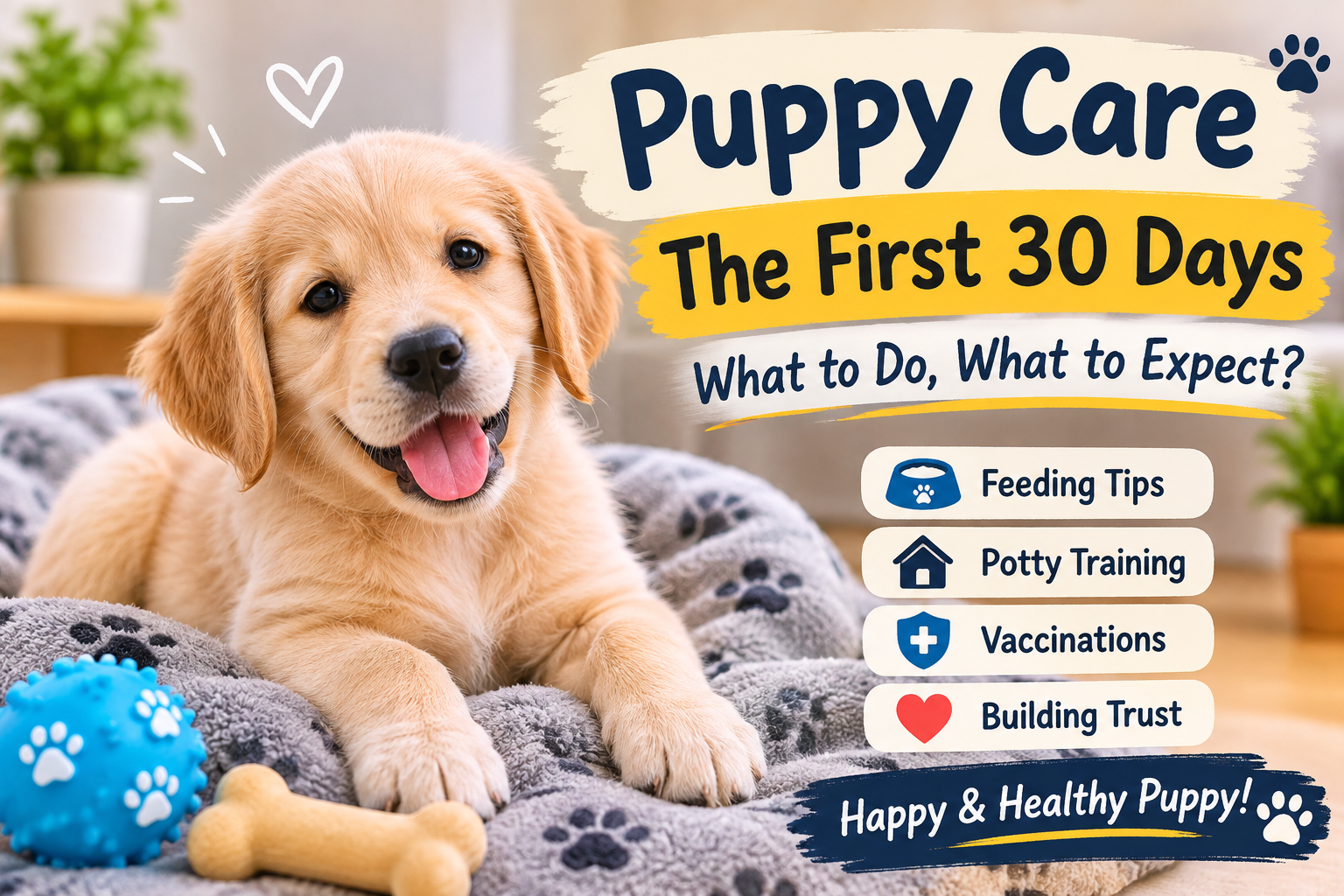
Bringing a new puppy home rarely goes according to plan. On the very first night, an eight-week-old pup might cry in their crate at 2:00 AM, refuse to settle alone, or pee on the living room rug two minutes after coming back indoors.
It helps to look at things from their side. Until today, your puppy had their mother, littermates, and familiar smells around them all the time. Now they are in a brand-new house with people they do not know yet.
Because of that adjustment, the first 30 days with a new puppy are less about obedience training and more about helping them feel at home while building a steady daily rhythm below, you will find what to set up before pickup day, a flexible daily routine, how the first four weeks usually unfold, vet-reviewed vaccine and exercise guidance, and simple fixes for common first-month headaches.
Before Pickup Day: Preparing Your Home and Supplies
Sorting out your space before your puppy arrives keeps those first few days much calmer and prevents avoidable accidents.
Puppy-Proofing at Floor Level
Get down on your hands and knees to spot anything a curious mouth can reach:
- Tuck away cables: Hide phone chargers, TV wires, and extension cords behind furniture or inside cord sleeves.
- Lock low cupboards: Move floor cleaners, medicines, and toxic foods (chocolate, grapes, raisins, onions, garlic, and products containing xylitol) onto high shelves.
- Clear small objects: Pick up socks, hair ties, coins, kids toys, and loose curtain cords.
- Set up a home base: Use baby gates or a playpen to section off one easy-to-clean area, like a tiled living or dining room, with their crate and water bowl.
New Puppy Essentials Checklist
You do not need to buy out the pet store on day one. Stick to the practical items you will use right away:
- Feeding and hydration: Two heavy stainless-steel or ceramic bowls that resist tipping, a one- to two-week supply of the exact puppy food your breeder or shelter uses, and soft, pea-sized training treats.
- Sleep and confinement: An appropriately sized crate with a divider panel so you can adjust the space as they grow, a washable crate mat, and a sturdy playpen. Skip expensive plush beds until early chewing habits settle.
- Walks and identification: A lightweight flat collar with an engraved ID tag showing your phone number, an adjustable Y-front harness, and a standard 4- to 6-foot leash.
- Play and enrichment: Durable rubber chew toys to redirect sharp puppy teeth away from fingers, plus a stuffable puzzle toy or lick mat for quiet crate time.
- Grooming, cleanup, and paperwork: A soft bristle brush, tear-free puppy shampoo, puppy nail clippers, an enzymatic stain remover to break down urine odours completely, poop bags, and all prior vaccination, deworming, and microchip records.
If you are still gathering supplies, you can browse curated puppy starter kits and nutrition options before pickup day.
Two Things to Sort Out Early
- Book a vet visit within 48 to 72 hours: Bring all vaccination and deworming records from the breeder or shelter so your veterinarian can confirm upcoming due dates.
- Agree on household rules: Decide beforehand whether your dog can be on sofas, who handles early-morning toilet breaks, and which cue words everyone will use for instance, say “Off” when paws jump up, rather than “Down,” which means lie down).
A Sample Daily Routine for Your New Puppy
Think of the outline below as a loose example rather than a strict clock-watching schedule. Exact meal times, nap lengths, and toilet breaks will shift depending on your puppy’s age, breed size, and individual bladder rhythm.
Instead of watching the clock, follow a repeatable loop wake up, go out to pee, eat or play, go out to pee again, and take a nap. Depending on their age and growth stage, young puppies often sleep around 16 to 20 hours across a 24-hour day. As a general observation rather than a strict rule, staying awake much longer than 45 to 60 minutes at a stretch leaves many young pups overtired, nippy, and hard to settle.
- Morning (6:30–8:00 AM): Wake up, carry or walk your puppy straight from the crate to the toilet spot before excited greetings, serve breakfast, take a post-meal toilet break, and enjoy 15 minutes of gentle play.
- Mid-Morning (8:00–11:30 AM): Settle in the crate or playpen with a stuffed chew toy for a 1.5- to 2-hour nap, followed by a toilet break, a 3-minute training session, and another short rest.
- Afternoon (12:30–4:30 PM): Head out for a toilet break, serve lunch in a puzzle feeder or slow bowl for mental stimulation, take a post-lunch toilet break, do some calm household exposure, and settle down for a 2-hour nap.
- Evening (5:00–8:00 PM): Take a toilet break, enjoy low-key play and sniffing time, serve dinner, take a post-dinner toilet break, and offer a quiet chew toy so your puppy winds down easily before bed.
- Night (9:30–10:30 PM): Take one final toilet break before lights out. Keep middle-of-the-night toilet trips quiet and brief, with no talking, bright lights, or play.
Toilet Timing Tip: Puppies often need to relieve themselves soon after waking up, eating, drinking, or finishing active play frequently within 10 to 20 minutes, though individual timing varies. Heading outside before they start sniffing in circles prevents many indoor accidents.
How the First Four Weeks Usually Unfold
Every puppy adjusts at their own pace, so treat these weekly stages as flexible goals rather than strict deadlines.
Week 1 (Days 1–7): Settling Into a New Home
Everything smells unfamiliar during week one, and separation from littermates often causes nighttime whining or hesitation around new rooms. Keep your puppy’s world small at first. Take them straight to their toilet spot upon arrival, then keep them in their puppy-proofed room or playpen rather than opening up the entire house. Avoid overwhelming your puppy with crowds introduce any visitors calmly, one or two at a time, and let the puppy approach at their own pace.
Place the crate beside your bed for the first few nights so your puppy knows you are nearby. During waking hours, start teaching their name by saying it once cheerfully and rewarding eye contact with a piece of kibble. As the week goes on, most puppies gradually start trotting over when they hear your voice and settling a little more easily after meals, though shy pups may take longer.
Week 2 (Days 8–14): Feeding Schedules and Toilet Habits
Once initial shyness fades, your puppy’s appetite picks up and they start testing boundaries around the room. Most 8- to 12-week-old puppies eat 3 to 4 measured meals daily toy breeds sometimes need smaller, more frequent meals to keep blood sugar steady. Use your food bag’s chart as a starting point, and switch to any new brand gradually over 7 to 10 days.
For toilet training, keep soft treats in your pocket so you can reward your puppy within two seconds of finishing outdoors waiting until you walk back inside rewards coming through the door rather than peeing outside. You can also introduce Sit and Come in two or three 3-minute sessions a day. By the end of week two, you will likely start recognising your puppy’s pre-pee body language, and daytime accidents usually drop when post-nap breaks happen on time.
Week 3 (Days 15–21): Safe Socialisation and Gentle Handling
Curiosity peaks right as a puppy’s primary socialisation window begins closing around 12 to 14 weeks of age, according to the official American Veterinary Society of Animal Behavior (AVSAB) Position Statement on Puppy Socialization. Safe exposure can and should begin before your puppy finishes their full vaccination series, provided outdoor activities are guided by local infection risks and your veterinarian’s advice.
Rather than waiting until all shots finish or exposing an unvaccinated pup to high-risk areas, focus on controlled, positive experiences. Carry your puppy through calm outdoor areas while keeping them off potentially contaminated ground and away from overwhelming crowds, let them observe everyday traffic from a parked car or clean blanket, arrange playdates only with healthy, vaccinated dogs in private homes, and pair household sounds doorbells, vacuum cleaners, umbrellas with treats. Hold off on shared public grass and dog parks until your vet confirms your puppy is protected. You can find more ideas in our safe puppy socialisation guide.
Veterinary Insight from Dr. Ananya Sharma, BVSc & AH: In practice, many of the adult dogs I see who struggle with routine ear exams, nail trims, or grooming were never handled calmly as puppies. Two minutes of gentle, treat-paired touch every evening touching paws, lifting ear flaps, brushing the coat, and rubbing a finger along the gums pays off for the rest of a dog’s life.
Week 4 (Days 22–30): Leash Practice and Short Alone Time
By week four, your puppy knows the layout of your home and often follows family members from room to room. Clip a light leash to their harness indoors and let them drag it under supervision before picking up the handle, rewarding calm steps beside you. To build comfort with being alone, start with 5 to 10 minutes in a playpen or crate with a stuffed chew toy while staying in sight or in the next room, working up to 20 or 30 minutes only as your puppy stays relaxed.
What to realistically expect by Day 30: Progress varies widely depending on breed, age at adoption, and temperament. Some puppies sleep through longer stretches of the night and move toward the door when they need to go out, while others still need a midnight toilet trip and make mistakes when excited. Aim for steady progress rather than a finished product.
Puppy Healthcare: Vaccines, Deworming, and Safe Exercise
(Medical Note: Individual vaccination, parasite prevention, and healthcare plans vary based on your puppy’s age at adoption, maternal antibody levels, Indian veterinary regulations, and regional disease risks. Always confirm exact schedules and outdoor clearance with your veterinarian.)
Standard Puppy Vaccination and Deworming Overview
In line with the World Small Animal Veterinary Association (WSAVA) Vaccination Guidelines, core puppy vaccines protect against Canine Distemper, Canine Adenovirus (Hepatitis), and Canine Parvovirus often administered alongside parainfluenza in combination formulations. Because antibodies from a mother’s milk can temporarily block early vaccine responses, doses typically start between 6 and 8 weeks of age and continue at 3- to 4-week intervals until at least 16 weeks of age:
- 6 to 8 Weeks (Initial Core Vaccine and Deworming): Begins protection with the core vaccine series alongside vet-guided deworming.
- 9 to 12 Weeks (2nd Core Booster and Deworming): Builds stronger immunity as natural maternal antibodies decline.
- 13 to 16+ Weeks (Subsequent Core Boosters and Rabies Vaccine): Continues at 3- to 4-week intervals until at least 16 weeks of age (some puppies require an additional booster beyond 16 weeks depending on veterinary assessment). Rabies vaccination is typically administered from 12 weeks of age onward in accordance with applicable Indian regulations and your veterinarian’s protocol.
- Routine Parasite Control (Per Vet Schedule): Ongoing deworming and flea or tick prevention tailored to your puppy’s age, weight, and local parasite risk.
You can track upcoming doses using our complete puppy vaccination and deworming schedule.
Veterinary Insight from Dr. Ananya Sharma, BVSc & AH: Protection does not become effective the moment the final injection is given the immune response develops gradually, and the exact timeline varies from puppy to puppy. Always check with your veterinarian to confirm when your puppy is adequately protected before visiting public parks or high-dog-traffic areas.
Age-Appropriate Exercise for Growing Joints
Growth plates at the ends of a puppy’s long bones close at different ages depending on breed size and individual development often around 12 to 18 months in medium, large, and giant breeds, and earlier in small breeds. Normal movement like exploring a room or climbing a few low steps under supervision is fine, so keep your focus on avoiding repetitive, high-impact strain such as forced jogging, frequent flights of stairs, or jumping from heights. Stick to short, sniff-led walks and free play on non-slip surfaces where your puppy can rest whenever they choose, checking with your vet on exercise suited to your dog’s breed.
Common First-Month Challenges and Practical Fixes
Even with steady routines, hiccups are part of raising a puppy:
- Mouthing and biting: Puppies explore with their teeth, especially as teething discomfort picks up. Avoid physical punishment or yanking your hand away fast, which triggers chasing. Calmly redirect their mouth onto a rubber chew toy, or a clean, frozen wet washcloth used under supervision. Some puppies pause when you let out a calm ” ouch, while others get more excited by vocal reactions. If biting continues, quietly stand up and step behind a baby gate for 15 seconds to pause play.
- Skipping meals: While a change in environment, unfamiliar bowls, or a new diet can affect appetite, refusing food in a young puppy should never be brushed off automatically. You can try serving meals in a quiet corner, using a flat ceramic plate if shiny metal bowls startle them, or moistening dry kibble with warm water, and picking up unfinished food after 15 to 20 minutes. Important veterinary note Young puppies especially toy breeds can develop low blood sugar (hypoglycaemia) quickly if they miss meals. Contact your veterinarian promptly if your puppy refuses more than one meal, or immediately if food refusal is accompanied by vomiting, diarrhoea, weakness, or lethargy.
- Nighttime crate accidents: Young puppies do not always whine reliably before urinating in their sleep area. Depending on your puppy’s age and individual bladder control, setting a gentle alarm for one scheduled middle-of-the-night toilet break during weeks one and two following the quiet, lights-low approach in our daily routine above can help reduce nighttime crate accidents.
- Getting distracted outside and peeing indoors: Puppies easily get distracted outdoors by smells and movement, forget to pee, and relax once back indoors. Stand still in one designated outdoor spot until they relieve themselves, then reward right away. Clean every indoor accident thoroughly with an enzymatic cleaner, as standard household disinfectants leave scent residues that encourage repeat marking.
Emergency vs. Prompt Veterinary Care: Warning Signs
Seek emergency veterinary care immediately if your puppy shows:
- Repeated vomiting or watery or bloody diarrhoea
- Extreme lethargy, collapse, weakness, or pale gums
- Laboured breathing, persistent coughing, or a swollen, painful abdomen
- Refusal to eat or drink in a toy-breed puppy, or any puppy showing signs of pain
Contact your veterinarian promptly for assessment if you notice:
- Skipping more than one scheduled meal without other symptoms
- Mild loose stools lasting more than 24 hours, nasal discharge, or sudden limping
Conclusion:
The first 30 days with a new puppy are about building trust, establishing steady routines, and learning how your puppy communicates, not achieving perfect behaviour. Toilet habits and basic cues take several months to become reliable, so expect good days and messy mornings side by side.
With patience, consistent guidance, and regular check-ins with your veterinarian, those early weeks gradually turn into a lasting bond. Whenever you need practical care guides or everyday puppy essentials for the months ahead, Hyepets has resources to support each stage of your dog’s growth.

 All Products
 All Products
 All Products
 All Products
 All Products
 All Products
 All Products
 All Products
 Combos
 All Products
 All Products
 Combos
 Combos
 Goat Milk Treats
 Combos
 Combos
 Combos